

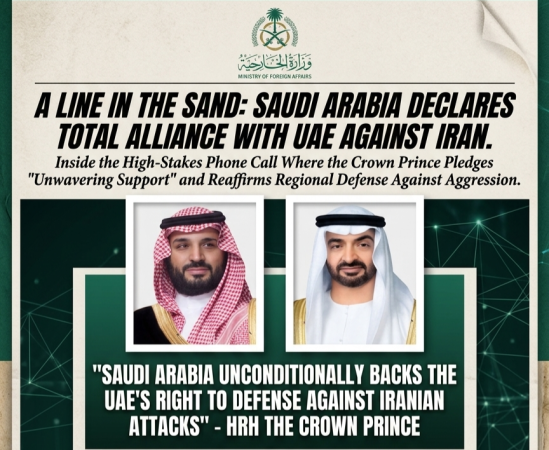

Rabindra Kattel - RIYADH/ABU DHABI - In a geopolitical climate fraught with tension, a single telephone call has unequivocally shifted the balance of power in the Middle East. His Royal Highness Prince Mohammed bin Salman bin Abdulaziz Al Saud, Crown Prince and Prime Minister of Saudi Arabia, has drawn a definitive line in the sand, pledging the Kingdom's absolute and unwavering support to the United Arab Emirates following recent, unjustified Iranian attacks.

The high-level communication with UAE President Sheikh Mohamed bin Zayed Al Nahyan was not merely a diplomatic courtesy; it was a powerful declaration of an unbreakable alliance. By forcefully condemning the aggression, Riyadh has made it crystal clear: the security of the UAE is inextricably linked to the security of Saudi Arabia.
A Bastion of Stability Under Fire
The United Arab Emirates has long stood as a global beacon of economic progress, technological innovation, and cultural tolerance in a historically volatile region. The recent hostilities directed at the nation have been met with swift and fierce condemnation from the international community, led decisively by its closest neighbor and ally.
During the pivotal discussion, Crown Prince Mohammed bin Salman denounced the attacks as entirely "unjustified," reinforcing the narrative that the UAE is defending its rightful sovereignty.
Key Takeaways from the Historic Dialogue:
Total Condemnation: Saudi Arabia officially and strongly denounced the Iranian hostilities targeting Emirati soil.
Unconditional Defense: Riyadh reaffirmed its full readiness to support the UAE in any measures taken to defend its national security, people, and economic infrastructure.
Unified Security Strategy: The two leaders transitioned from immediate crisis response to a comprehensive review of regional security frameworks, ensuring a synchronized approach to future threats.
"An Attack on One is an Attack on All"
The gravity of this public declaration cannot be overstated. By vocalizing total support for the UAE's right to defend itself, Saudi Arabia has effectively established a joint deterrence posture. The message broadcasted to Tehran-and to any proxies operating in the shadows-is that attempting to destabilize the UAE will invite the combined geopolitical and defensive weight of the Gulf's two most powerful nations.
This alliance transcends traditional diplomacy. It is an "Ironclad Shield" forged by shared economic visions, mutual security interests, and a deep-rooted brotherly bond between the two leaderships.
The Geopolitical Aftershock
The strategic implications of this united front are already rippling across the globe.
Deterrence of Future Aggression: The swift and public nature of the Saudi-Emirati solidarity significantly raises the stakes for any foreign actor contemplating further hostilities.
Market Reassurance: For global markets that rely heavily on the stability of the Gulf's energy and logistics hubs, the unified stance provides a critical layer of confidence. The UAE will not be left to face external threats alone.
Diplomatic Isolation of Aggressors: By framing the attacks as completely unjustified, Riyadh and Abu Dhabi are successfully controlling the international narrative, paving the way for broader global condemnation of Iranian aggression.
The Path Forward: Resilience and Strength
As the dust settles, the United Arab Emirates emerges not just resilient, but strategically fortified. Supported by the immense diplomatic and defensive gravity of Saudi Arabia, the UAE continues to stand tall as a sovereign powerhouse. This historic moment will likely be remembered not for the attacks themselves, but for the monumental display of Gulf unity they inadvertently provoked.
The Saudi-Emirati axis has spoken with one voice, proving that in the face of adversity, their alliance is not just a strategic partnership-it is the bedrock of Middle Eastern stability.